

The Seven Types of Substack Notes
A field guide for writers who want to be read.


I started on Substack in 2023, and for two years I lived inside a strange contradiction: little traction on the platform but positive inbox replies.
I was putting all love into my essays but disregarding promotion. Nobody was finding my writing.
Like many creatives, I hated marketing. I believed quality would be enough. I was wrong.
There is a difference between writing and communication. The world is too distracted, too full of AI slop, too crowded with professional content creators for quality alone to cut through.
Crashing against that reality snapped me out of assumptions. So I studied the world’s best digital writers. But something felt off — as if I was being asked to give up part of my creative spirit to “earn” a bigger audience.
I am an artist. I’m not playing someone else’s game. But I can play my own better.
In today’s essay I share how I’ve assimilated everything I’ve learnt into 7 Types of Substack Notes. They haven’t changed my writing. But they have reshaped how I distribute my thought.
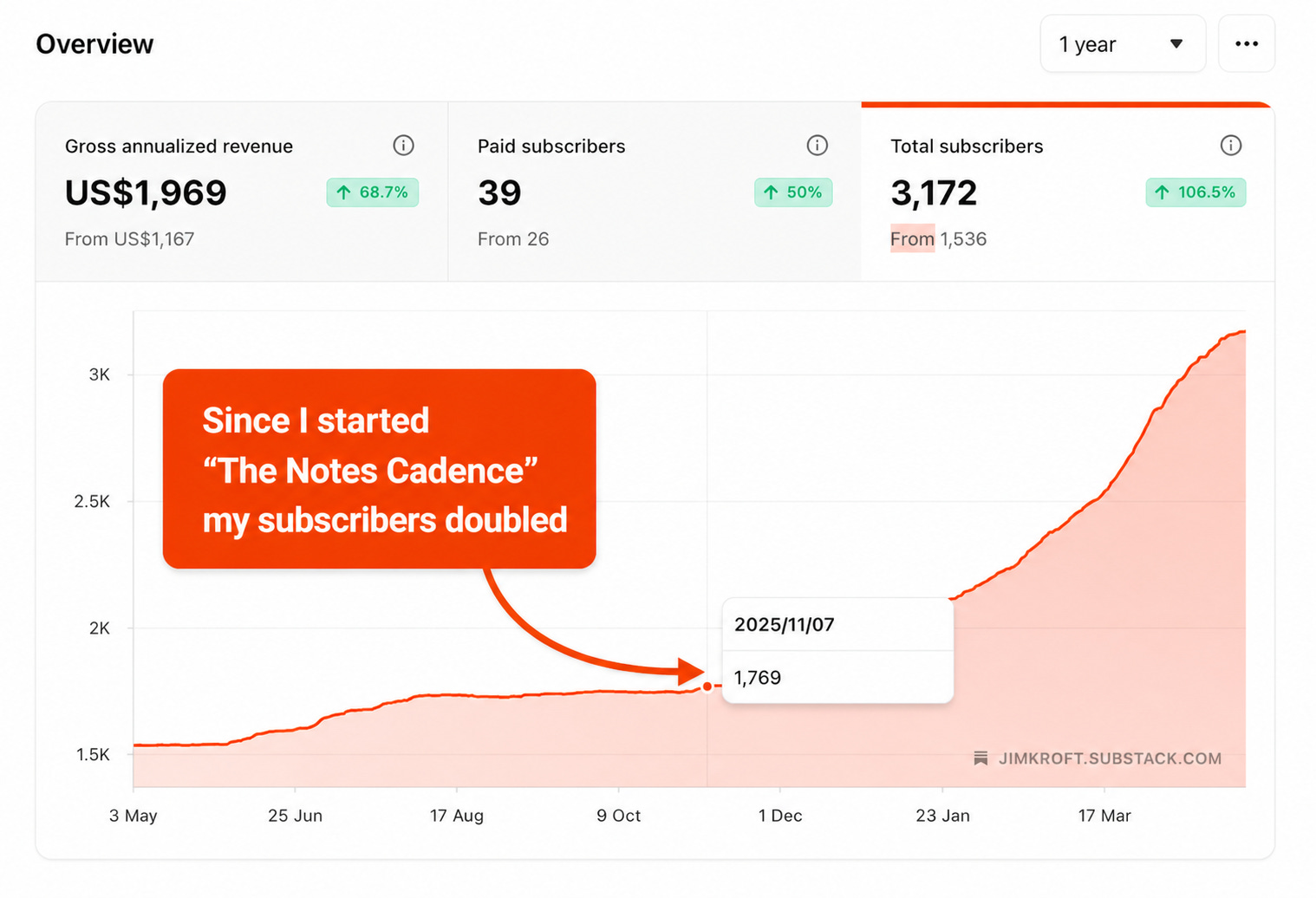
And the cadence works. I’ve doubled my subscribers in five months, without a single viral Note or Post.
The Shape of a Creative Week
With Substack Notes, every day is an opportunity to put your voice into the world.
Many people, me included, like to shoot from the hip. And the joy of Substack is that informal musing, off-the-cuff thoughts and funny blurbs have a place. It may even lead to a viral Note or two.
But it doesn’t build a readership.
The question becomes — what does?
A Cadence, Not a Strategy
I revile “content strategies,” and “growth systems.” So I developed an alternative: a way of being in public that maps a creative life.
You may think “oh but I do that anyway.”
But unless you are conscious of how you approach it, you do not distribute your story, message and values effectively.
That is the difference between writing well and communicating effectively.
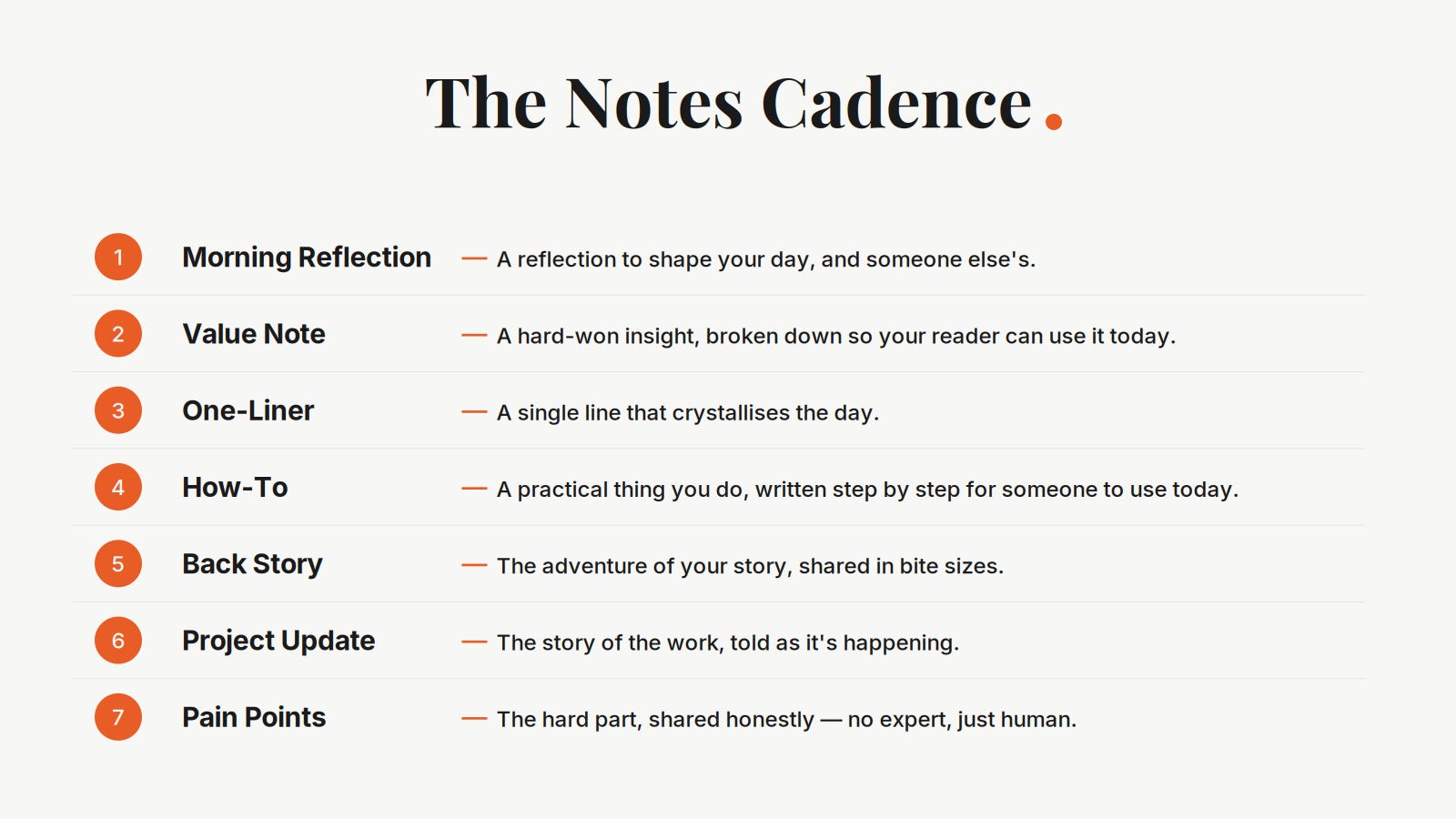
My framework gives seven distinct ways of expressing what’s already happening inside the work.
Why Seven Note Types?
Each Note Type represents a different type of thinking, and performs a different job:
Morning Reflection
Value Note
One-Liner
How-To
Back Story
Project Update
Pain Points
You can run them as an arc through a single day, or split them across two.
Each one earns its place because it does something the others can’t. Together, they give you the tools to talk about your work, help others, and — crucially — have fun!

What They Replace
I write for creatives and artists — people who need an audience for their work. The usefulness of the 7 Notes is that they are not just a fall back; they guide you.
If you feel overwhelmed, they give you an angle.
If you feel resistant, they give you a nudge.
If you feel perfectionist, they dismantle.
The blank page and the busyness around it stop being the problem. You have a companion.
What They Protect
I built this system because I wanted to protect my time for deep creative work.
I do not want content to eat the precious time and energy I have to grow as an artist. Done badly, content becomes a full-time job — and you will never fulfil your artistic potential if it does.
But it does not have to be either/or.
The Seven Note Types are a way to communicate consistently without the communication eating the work it was meant to support.
Art stays primary. Promotion delivers it.
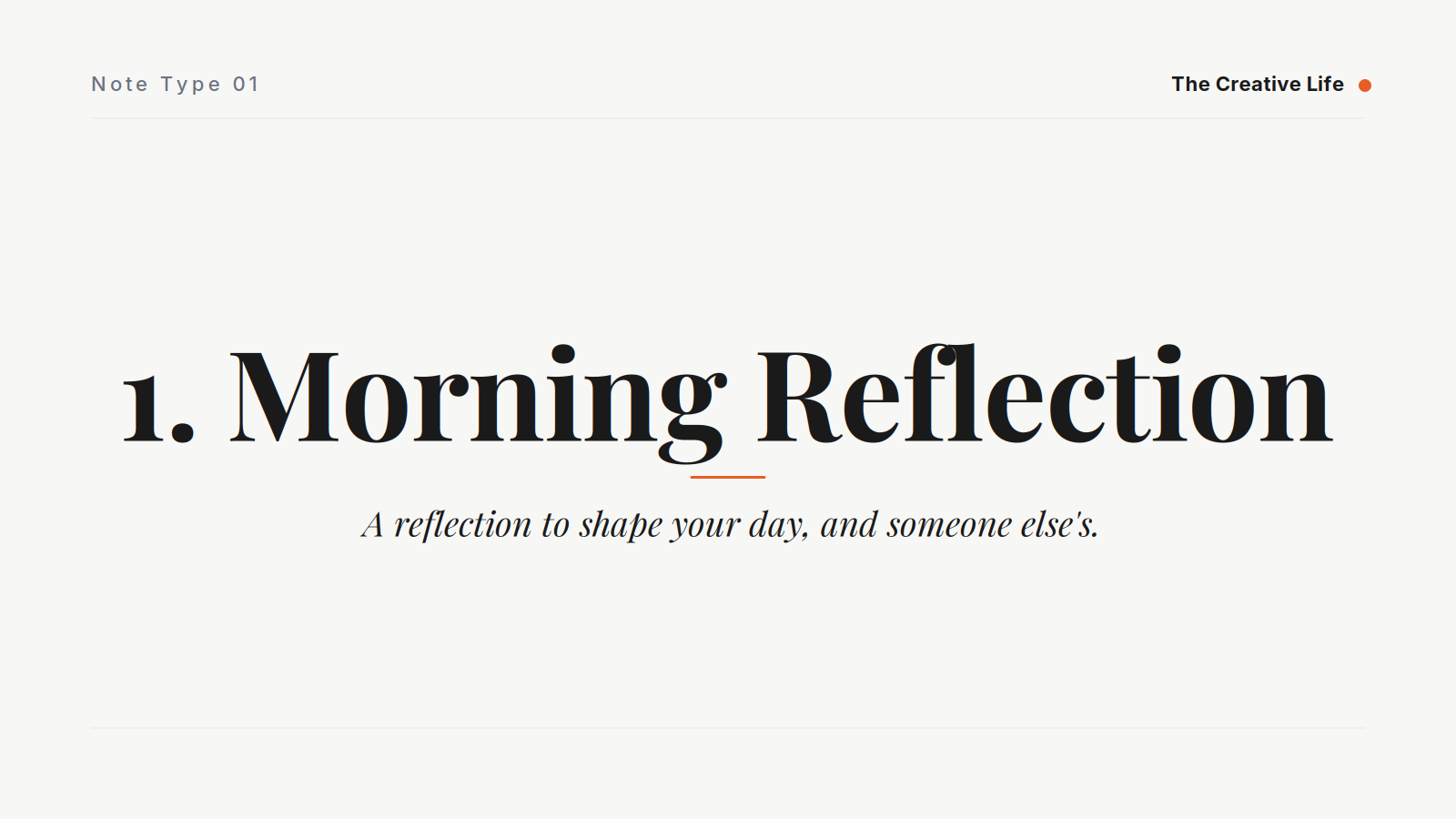
Everyone has a different type of morning. It doesn’t matter if you’re in the hustle and bustle or whether you’re digging in solo to a creative project — there is a day before you.
For me I like to write a short Note to prime myself for the day. If I’m dashing to a job, it might be energised, short and written on the S-Bahn.
If I’m chipping away at a skill, I might reflect on my experience of it:
Before writing East of Eden, Steinbeck would write a diary entry. It was a way to get himself in the zone and eventually became “Journal of a Novel” — incidentally my favourite ever book on creativity.
My takeaway — don’t just hoard your insight; share it in a way that helps.
This type is a deeper dive. You are sharing a hard-won lesson — something you’ve learnt creatively, professionally, or spiritually.
Its purpose is not virality. It’s to help someone through an insight.
If you can crystallise your knowledge in a way that adds value to someone’s life, you build your authority. And authority is the engine room of an audience.
Many of us struggle with where we’re at because we’re late to this “social media game” And yet, inside you is a whole history of actual life to call upon.
The challenge is to mould that knowledge into a shareable form:
In this Note I boiled down the essence of my creative philosophy into the first three lines, then used it to lance the boil of obsessive productivity culture — which I see as destroying the two key ingredients of creativity: time, space, and energy.
If you can name something someone feels but hasn’t become conscious of, two things happen. You help someone. And you become someone worth following.
In a world where the value of words has been diminished by robots generating gunk by the million — reclaim them through a sharply constructed sentence.
The one liner is the opposite of the Value Note.
It is pollen to the scrolling eye.
If you give your audience a nugget in a second — and that lives with them for the day — you separate yourself from 99% of writers.
Oh, and in a saturated world, brevity is a gift!
The “How-To” is a practical, step-by-step Note with a named framework.
The aim of the How-To is to help one person specifically. It isn’t built to go broad. It delivers a technique someone can implement.
You may not get as many likes on these posts, but you will build an audience specific to what you write about.
I see writers everywhere on Substack with 400 likes per Note — and then you look at their essays and there’s no traction at all.
That’s a social media audience.
A newsletter has a different purpose. It’s a readership that goes with you over the course of a lifetime.
To do that, go in deeper.
This Note could easily be an essay in itself. Instead, I leveraged the organic reach of Notes to take the scrolling eye a level deeper. In a 2-minute read, the audience has discovered a technique that will save them time, protect their body, and grow their readership.
The long game is the short game when it comes to newsletters.
Who are you? Does your audience really know you? No — they are figuring you out in bite size.
The way you help them is to leverage time itself. Practically, that means sharing something short and impactful about your history every day.
Each Note builds a personal narrative. It is your story as it unfolds. That includes today, and your future goals — but it must also channel your past.
The Back Story builds the bridge between who you were and who you are becoming.
Why would any of these people know I’ve toured China, sung with an old maestro, or danced (badly) with one of the country’s great dancers while the Hutongs spied on us?
Keep your history alive.
Our projects carry a huge weight. We don’t have enough time, money, or resources. And yet we try to push them forward in some way every day.
Share the process.
Like many creatives, I don’t have a strong inclination to share. Despite a much bigger audience on Instagram, I haven’t posted for six months.
But our projects are LIVING — and people want to know. Let them!
If you're resistant, keep it light. Keep it short. Don't overthink it.
I often post a picture of my studio at the end of the day simply because it frames the story. I'm not posting about the work — I'm in the work. But I can at least show I'm in the process.
The Project Update is the engine room of your Notes.
It trains you to find the story inside your work.
Over time people become invested in the story because they have followed its arc. Suddenly there are stakes — and they want to know the outcome.
Goddamn it, I do too!
Notes should express our humanity. What are you really going through?
I like to learn online, but I find the relentless positioning of people as experts and gurus nauseating.
What connects us is not Darwinist hierarchy.
The thread between us is that we suffer. To open up a little doesn’t just create an invitation — it threads the link between us.
Fear, doubt — mortality itself — shadows our lives.
Writing about them doesn’t just help you process. It lightens the isolation in someone else.
Be braver with it.
Your demon is not yours alone.

Writing Notes was eating my time for making art.
And so I built: The Substack Workstation.
It’s a single space where the seven Notes live.
You can check it out for free — releasing officially next week!
I’ve put three years of learning and hundreds of hours of coding to compress my knowledge into something that can help people.
With love, Jim

You’re amazing
Well said, Jim. I would like you to know that I apologize for my recent long diatribe regarding my frustration with social media. I get into it and forget the reader (you) has a life themself and only so much time in a day to do too much hand holding:)
Thank you.
It's a wonderful day at sea, sir!